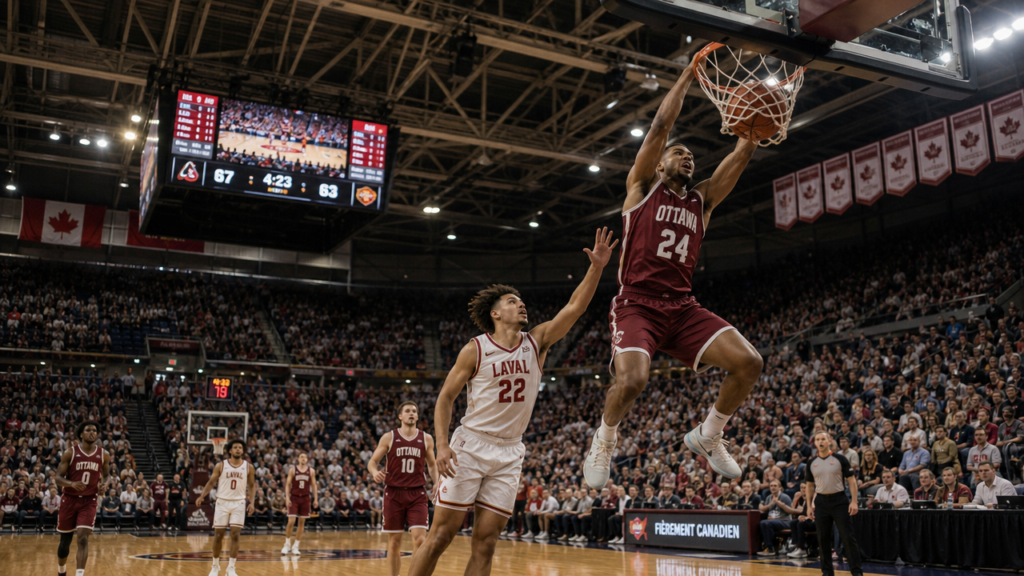
What is a dunk in basketball? A dunk is a two-point shot in which a player jumps and sends the ball directly down through the basket from above the rim. The term «slam dunk» entered broadcast vocabulary through Los Angeles Lakers announcer Chick Hearn. In modern NBA play-by-play data, a successful dunk converts at roughly 90 percent or better when the player is not heavily contested. That conversion rate makes it one of the most efficient shots in basketball, especially compared with mid-range jumpers and even above-average three-point attempts.
The high success rate comes from the release point. A player who gets the ball above the rim eliminates most of the defender’s ability to block the shot without fouling. The dunk also shortens the flight path of the ball, reducing variance from backspin, arc, and rim contact.
The Origin, Ban, and Revival of the Dunk
Dunking appeared in organized basketball during the 1930s, but it became a defining weapon for Wilt Chamberlain in the 1960s. The NCAA banned the dunk from 1967 to 1976. The most common explanation for the ban is that Kareem Abdul-Jabbar, then known as Lew Alcindor at UCLA, used it to overwhelm defenders. Some writers and fans viewed the rule as racist because it suppressed a playing style associated with Black athletes and shifted the advantage to smaller, less vertically explosive players.
The ban did not kill the dunk. It pushed attention toward the ABA, where Julius Erving made the dunk a central part of his game and the league’s identity. After the NCAA lifted the ban in 1976, the dunk continued to grow as a scoring tool and a marketing device. Georgiann Wells of West Virginia became the first woman to dunk in an official college game in 1984. Her dunk demonstrated that the skill depended on training and opportunity, not gender.
Equipment Changes After Backboard Breaks
Powerful dunks could shatter glass backboards, especially in the era of fixed rims and rigid supports. Repeated breaks forced arenas and manufacturers to develop breakaway rims and tempered glass systems that absorb force. The change reduced game stoppages and allowed players to hang on the rim without destroying equipment. This equipment shift made dunk attempts less risky for the player as well, since a broken backboard could lead to cuts and long delays.
Dunk Types and Why They Matter for Scoring
A basic one-hand or two-hand dunk is the most frequent type in NBA games. Tomahawk dunks, reverse dunks, windmill dunks, alley-oop dunks, self-alley-oops, 360 dunks, behind-the-back dunks, cradle dunks, and double-pump dunks all appear in official highlights and player tracking logs. In basketball media and anime, names like Meteor dunk or Mill dunk add another layer to a move that still counts for two points on the scoreboard.
The scoring value is identical across types, but the risk is not. A wide-open baseline reverse dunk might convert at 95 percent, while a contested 360 attempt can drop below 70 percent because of the extra rotation and defender recovery time. Bettors who ignore dunk type and only look at total dunks can misjudge quality. A player who takes safe two-hand dunks is a different proposition from one who forces highlight dunks under pressure.
Statistical Models for Dunk Efficiency and Frequency
Expected Points: Dunk vs. Three-Pointer
A simple expected points calculation shows why dunks drive offensive efficiency. If a player converts 90 percent of dunk attempts, the expected value is 1.8 points per shot. A 36 percent three-point shooter produces 1.08 points per shot. That gap of 0.72 points per attempt is larger than the difference between most free throw shooters and average three-point shooters. Teams that create more dunks do not just score more; they force defenses to collapse, which opens outside shots.
The calculation changes when free throws are included. A dunk attempt can draw a shooting foul, and an and-one adds about 0.7 to 0.8 expected points depending on the player’s free throw percentage. A three-point attempt can also draw a foul, but those events are less frequent. That is why offenses that generate rim pressure tend to have higher floor and ceiling outcomes.
Projecting Player Dunk Attempts
Player dunk props often use a Poisson or binomial model based on minutes, role, pace, and opposing rim protection. Suppose a center averages 3.1 dunk attempts per 36 minutes against average defenses. Facing a top-five rim protection team with a 7-foot center might lower that projection to 2.2 attempts. Against a bottom-five defense that allows early seals and lobs, the same player might project for 4.0 attempts. The model compares that projection to the sportsbook’s line, not to the player’s season average alone.
Tracking data adds context. Defender distance at the catch, shot clock remaining, and whether the attempt comes in transition or half-court sets all influence dunk probability. A player who gets 70 percent of his dunk attempts in transition may be more volatile because transition opportunities depend on opponent turnovers and long misses. A player who dunks mostly on half-court rolls has a more stable baseline, but his output depends on pick-and-roll coverage.
Betting Trends in Dunk Markets
Player Dunk Props and Line Movement
Sportsbooks set player dunk totals, such as over 1.5 dunks at -120 or under 1.5 at +100. These lines move when starting lineups, injuries, or matchup data change. A starting center ruled out can shift a power forward’s dunk prop by half an attempt or more because his role changes from floor spacer to roll man. Sharp bettors track lineup notes and pregame warmups before attacking these low-liquidity markets.
The over is not always the value play. A player can have a high dunk total but a poor matchup against a team that plays drop coverage with a shot-blocking center. If the opposing center stays near the basket, lobs and rolls become harder. In that case, the under might be more attractive even if the player is popular with public bettors. Checking the opponent’s defensive scheme matters more than the player’s last three games.
First Basket and Team Dunk Props
Dunk markets extend beyond player totals. Some books offer first field goal type props, where a dunk as the first score pays longer odds than a layup or jump shot. Team dunk totals also appear for NBA games and NCAA tournament contests. A team that pushes pace after missed shots may hit a team dunk line more often than a half-court team with a slower point guard.
Lineup data drives these bets. When a backup center enters, the frequency of pick-and-roll dunks can rise because backups often play a rim-running role. When a stretch big replaces a traditional center, team dunks may fall. Checking substitution patterns and opponent foul trouble gives a bettor an edge before the market adjusts.
Historical Data and Modern Dunk Trends
The NCAA ban from 1967 to 1976 is the clearest historical marker of how much the dunk mattered. After the ban ended, dunk attempts grew with ABA influence and later with NBA marketing around stars like Julius Erving, Michael Jordan, and Vince Carter. Modern play-by-play data shows that transition possessions produce a larger share of dunks than half-court sets, and teams with high pace generate more dunk chances per game.
Georgiann Wells made the first official college dunk by a woman in 1984. Her achievement showed that dunking was not a fixed physical barrier. Now women’s basketball players at the college and professional levels use dunks in games, though the frequency remains low. Data models for women’s basketball dunk props are rare, but the same expected points logic applies: a made dunk is worth two points and converts at a very high rate.